


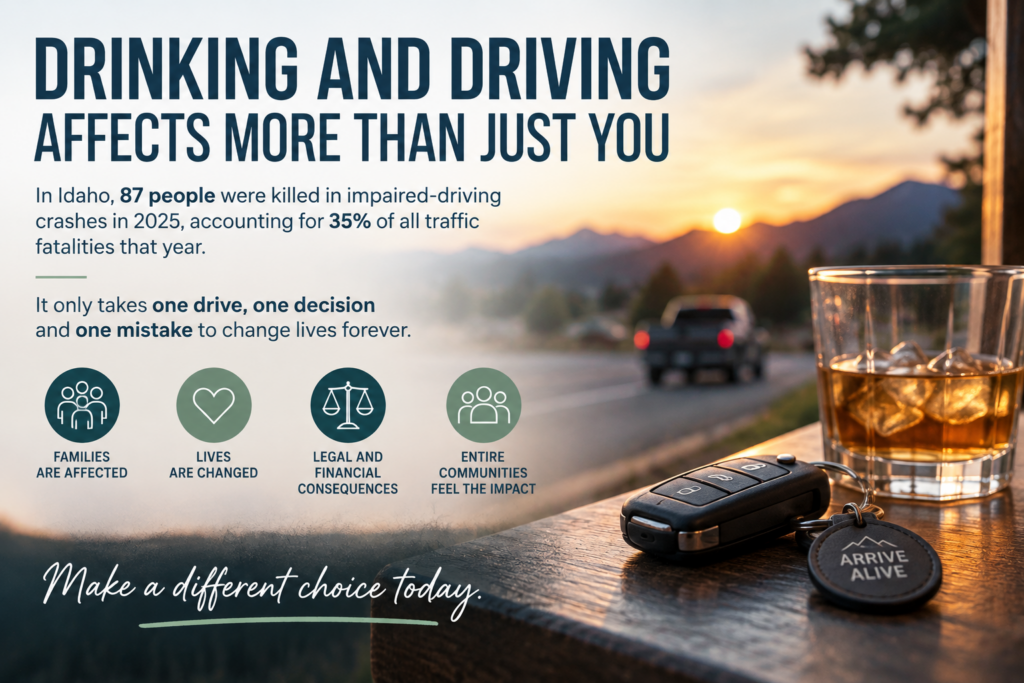
There are decisions that can be taken back. Drinking and driving is not always one of them.
A night out with friends. Dinner and a few drinks. A celebration. Someone believes they are “fine to drive,” gets behind the wheel and starts home. Then, in a matter of seconds, everything can change.
For families across Idaho, the consequences of impaired driving are not statistics on a page. They are an empty seat at the dinner table. A child who loses a parent. Parents who lose a son or daughter. A family waiting at a hospital. And sometimes, they are another family trying to understand how someone they love made a decision that caused unimaginable harm.
The tragedy reaches every family involved.
And here in Idaho, the numbers remain deeply concerning. During Idaho’s 100 Deadliest Days of 2026, 90 people lost their lives in traffic crashes, with alcohol and drug impairment among the leading contributing circumstances identified by the Idaho Office of Highway Safety. Idaho Transportation Department
The problem is especially close to home in the Treasure Valley. According to Idaho State Police, between 2019 and 2024 the region experienced a 27% increase in alcohol-impaired driving and a 46% increase in impaired-driving fatalities. The Treasure Valley DUI Task Force was created in response to the rise in impaired-driving crashes and made 325 DUI arrests during its first year of enforcement operations. Idaho State Police
Statewide, 87 people were killed in impaired-driving crashes in 2025, accounting for 35% of all Idaho traffic fatalities that year. Idaho Transportation Department
Every one of those numbers represents a person and a family whose life changed. That is what makes drinking and driving in Idaho more than a traffic-safety issue. It is a community issue, a family issue and, for some people, a warning sign that their relationship with alcohol may be becoming harder to control.
Because it only takes one drive, one decision and one mistake to change lives forever.
DRINKING AND DRIVING IN IDAHO: A GROWING CONCERN
The numbers in Idaho tell a difficult story. While statewide impaired-driving deaths have fluctuated from year to year, the problem remains significant. In 2025, 87 people were killed in impaired-driving crashes in Idaho, accounting for 35% of all traffic fatalities in the state. Idaho Transportation Department
Here in the Treasure Valley, the trend is even more concerning. Between 2019 and 2024, alcohol-impaired driving increased 27%, while impaired-driving fatalities increased 46%. In response to the rise in impaired-driving crashes, law enforcement agencies throughout the Treasure Valley formed a dedicated DUI Task Force. During its first year, the task force made 325 DUI arrests during just ten emphasis operations. Idaho State Police
The danger is not limited to drivers who appear obviously intoxicated. Alcohol begins affecting the skills necessary for safe driving before someone may recognize how impaired they have become.
Alcohol can affect judgment, reaction time, vision, coordination and self-control. Idaho’s driver materials specifically note that judgment and self-control are among the first abilities affected as blood alcohol concentration rises. That creates a dangerous contradiction: the same substance impairing someone’s ability to drive can also impair their ability to accurately judge whether they are safe to drive. Idaho Transportation Department
Someone may think, I only had a couple.
I don’t feel drunk.
It’s only a few miles.
I’ve driven home like this before.
But feeling capable of driving and actually being capable of reacting to a vehicle suddenly stopping, a pedestrian entering the road, an unexpected curve or another driver’s mistake are very different things.
In Idaho, a BAC of 0.08% or higher for drivers 21 and older meets the state’s per se threshold for driving under the influence, with lower thresholds applying to drivers under 21 and commercial drivers. But the legal limit should not be mistaken for the point at which impairment suddenly begins. Idaho’s own driving materials describe coordination impairment beginning at lower BAC levels. Idaho Transportation Department
And the consequences can be permanent.
An impaired-driving crash can leave one family grieving someone who never made it home and another family grieving while also facing the legal, financial and emotional consequences of what happened. Friends, children, parents and entire communities can be affected by a decision that may have taken only seconds to make.
That is the tragedy of drinking and driving. Nobody gets into a car believing they are about to change multiple families’ lives forever. But it only takes one time.

WHY “I FEEL FINE TO DRIVE” CAN BE SO DANGEROUS
One of the most dangerous effects of alcohol is that you may not realize how impaired you actually are. Alcohol can affect judgment, reaction time, coordination and decision-making before someone appears obviously drunk.
That is why “I feel fine” is never a reliable way to decide whether it is safe to drive. A driver may feel in control while having a harder time reacting to sudden traffic, a pedestrian, an unexpected turn or another driver’s mistake.
Past experience can also create false confidence. Driving after drinking before and making it home safely does not mean it was safe. It simply means a crash did not happen that time.
If you have been drinking, make the decision before getting behind the wheel. Call a friend, use a rideshare, stay where you are or hand over your keys. One inconvenient ride home is nothing compared with a decision that could change your life and someone else’s forever
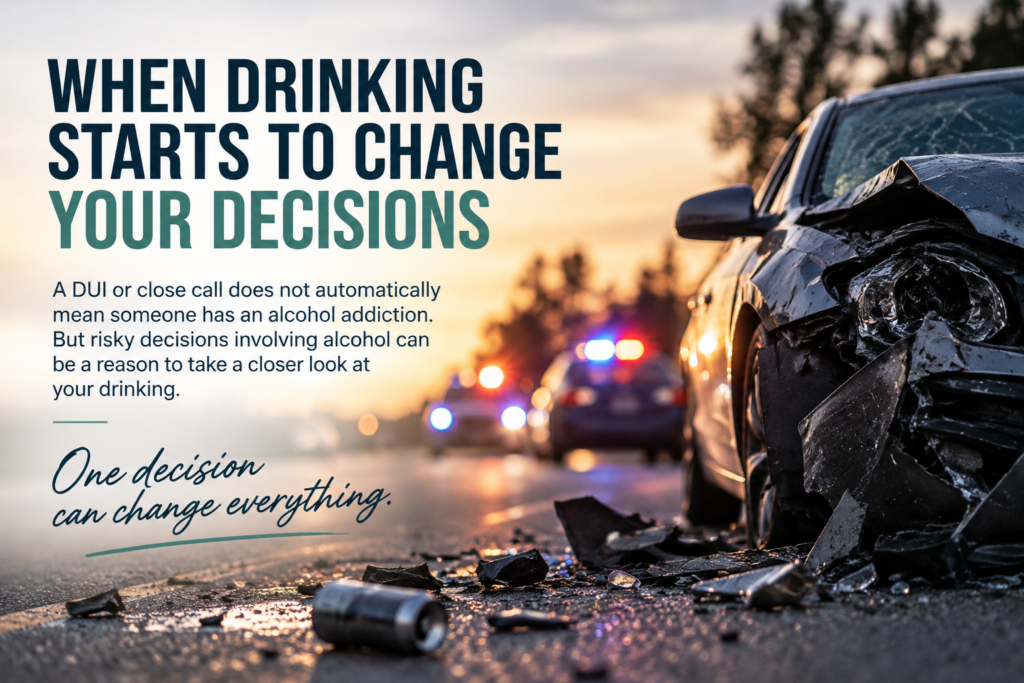
When Drinking Starts to Change Your Decisions
A DUI or close call does not automatically mean someone has an alcohol addiction. But risky decisions involving alcohol can be a reason to take a closer look at your drinking.
You might notice:
- You regularly drink more than you planned.
- You have driven after drinking or considered yourself “okay to drive.”
- Friends or family have expressed concern about your drinking.
- You have experienced blackouts or cannot remember parts of the night.
- You use alcohol to cope with stress, anxiety, sleep or difficult emotions.
- You have tried to cut back but keep returning to the same pattern.
- Drinking has caused problems at home, work or in relationships.
- You continue drinking even after experiencing serious consequences.
Patterns matter. Sometimes the warning sign is not how often someone drinks, but what begins happening when they do. A DUI, an accident or a frightening close call can be a wake-up call. You do not have to wait for something tragic to happen before asking whether alcohol is having too much control over your decisions.

“But I’m Not an Alcoholic.”
One reason risky drinking can be difficult to recognize is that many people have an idea of what an alcohol problem is supposed to look like.
Someone may think:
- “I only drink socially.”
- “I don’t drink every day.”
- “I still go to work and take care of my family.”
- “Everyone drinks like this sometimes.”
- “I’ve driven after drinking before and nothing happened.”
- “I can stop whenever I want.”
But you do not have to drink every day or lose everything for alcohol to be creating problems in your life.
A better question may be: Is drinking changing my decisions?
If alcohol is leading to dangerous choices, arguments, blackouts, missed responsibilities, driving when you should not, or repeated attempts to cut back, those patterns are worth paying attention to.
You Don’t Have to Hit Rock Bottom to Ask for Help
Alcohol problems can develop gradually. A person can have a career, raise a family, maintain friendships and appear completely functional while still struggling to control their drinking.
Waiting for a DUI, serious accident, lost relationship or another major consequence is not necessary before asking for help. In fact, recognizing the pattern earlier can provide an opportunity to make a change before one night or one decision becomes something that cannot be undone.
If you are questioning your relationship with alcohol, that question alone may be worth exploring. Help is not only for people who have lost everything. It is also for people who want to prevent that from happening.
A DUI Can Be a Wake-Up Call
A DUI can bring serious legal, financial and personal consequences. But when no one has been hurt, it can also be an opportunity to stop and recognize how much worse the outcome could have been.
You made it home before. This time you were pulled over. What happens next time?
For some people, a DUI is the first undeniable sign that alcohol is beginning to affect their judgment and decisions. Instead of viewing it only as a punishment, it can become a turning point.
A DUI is serious. But an impaired-driving crash that takes a life can never be undone.
If a DUI causes you to question your drinking, listen to that concern. Making a change today could prevent another arrest, an accident, or a tragedy that affects your family and someone else’s forever.
What If You Realize Alcohol Is Becoming Hard to Control?
Realizing that alcohol is affecting your decisions does not automatically mean you need to leave your job, family and home to enter residential treatment.
Alcohol treatment comes in different levels of care. The right approach depends on how much and how often you drink, whether withdrawal symptoms are present, your physical and mental health, and how alcohol is affecting your daily life.
For some people, the wake-up call is a DUI. For others, it is a close call, an accident, a worried family member or simply realizing that drinking has become harder to control.
At Zelus Recovery in Meridian, treatment is individualized based on the person, not a one-size-fits-all approach.
Zelus provides alcohol addiction treatment in Boise and the Treasure Valley through multiple levels of outpatient care, allowing many people to receive structured support while continuing to live at home.
Intensive Outpatient Program (IOP)
An Intensive Outpatient Program in Boise provides structured treatment without requiring someone to live at a treatment facility.
Treatment may address not only alcohol use itself, but also what may be contributing to it:
- Stress or anxiety
- Depression or difficult emotions
- Trauma
- Relationship or family problems
- Using alcohol to relax or sleep
- Difficulty controlling drinking once it begins
Understanding those underlying patterns can be an important part of making changes that last.
IOP can be especially helpful for people who need more support and accountability while continuing to manage work, school or family responsibilities.
Partial Hospitalization Program (PHP)
Some people need a higher level of structure and support.
Zelus Recovery’s Partial Hospitalization Program provides more intensive daytime treatment while allowing participants to return home outside treatment hours.
PHP may be appropriate when alcohol use has become more difficult to control, cravings or withdrawal are interfering with daily life, mental health concerns are also present, or someone needs more support than traditional outpatient treatment can provide.
You don’t have to know which program you need before reaching out. An assessment can help determine what is happening and what level of treatment may be appropriate.
Most importantly, you do not have to wait for another DUI, another close call or a tragedy to decide it is time for something to change.
You Don’t Have to Wait for Something Worse to Happen
Sometimes a DUI, a close call or waking up the next morning and realizing you drove when you should not have is enough to make you question your relationship with alcohol.
You don’t need to prove that your drinking is “bad enough.”
- You don’t have to call yourself an alcoholic.
- You don’t have to drink every day.
- You don’t have to hit rock bottom.
- And you don’t have to wait until someone gets hurt.
Sometimes Change Starts With One Question
- Maybe you’re wondering whether you drink too much.
- Maybe a DUI scared you.
- Maybe your family has expressed concern.
- Maybe you’ve promised yourself you wouldn’t drive after drinking again, but you have.
- Or maybe you simply know something needs to change.
You don’t have to wait for the next time to find out how much worse it could be.

You Don’t Have to Decide Whether You’re “Bad Enough” for Help
This may be the most important part of the conversation.
- You don’t need to prove that your drinking is severe enough.
- You don’t have to call yourself an alcoholic.
- You don’t have to hit rock bottom.
- And you don’t have to wait until alcohol causes a crisis.
Sometimes Recovery Starts With a Question
- Maybe you’re simply curious about what life would feel like without drinking.
- Maybe you’ve tried cutting back and can’t understand why it’s so difficult.
- Maybe someone you love has expressed concern.
- Or maybe you already know something needs to change.
All of those are valid reasons to have a conversation.
Alcohol Addiction Treatment in Boise and the Treasure Valley
Drinking and driving in Idaho affects more than the person behind the wheel. One decision can leave lasting consequences for drivers, passengers, families and entire communities.
If alcohol is beginning to affect your judgment, relationships or ability to make safe decisions, Zelus Recovery offers alcohol addiction treatment in Boise and the Treasure Valley with individualized outpatient options designed to meet people where they are.
Whether you are seeking help after a DUI, trying to prevent another close call or simply questioning your relationship with alcohol, reaching out can be the first step toward making a change.
A DUI can be a wake-up call. A tragedy cannot be undone. You do not have to wait for something worse to happen before asking for help.
Frequently Asked Questions About Drinking and Driving in Idaho
What is the legal alcohol limit for driving in Idaho?
For most drivers age 21 and older, Idaho’s per se BAC limit is 0.08%. Lower limits apply to drivers under 21 and commercial drivers. However, alcohol can impair judgment, coordination and reaction time before someone reaches 0.08%.
Can you get a DUI even if you don’t feel drunk?
Yes. Feeling “fine” does not mean you are safe to drive. Alcohol can impair judgment and reaction time while also making it harder to recognize your own level of impairment.
Does getting a DUI mean you have an alcohol addiction?
Not necessarily. A DUI alone does not diagnose alcohol use disorder. However, it can be an important reason to examine your drinking, particularly if alcohol has repeatedly led to risky decisions or other consequences.
Can a DUI be a wake-up call?
For some people, yes. A DUI or close call can become an opportunity to change drinking patterns before an impaired-driving crash causes an injury or death.
Can I detox from alcohol at home?
It depends. Alcohol withdrawal can be dangerous for some people. Ambulatory detox may allow appropriate patients to receive medical support while living at home, but a professional assessment should determine whether outpatient detox is safe.
Where can I get help for alcohol use in Boise?
Zelus Recovery in Meridian provides alcohol addiction treatment for Boise and the Treasure Valley, including outpatient treatment, IOP, PHP and ambulatory detox options. Treatment can be individualized based on your alcohol use, health, responsibilities and level of support needed.