
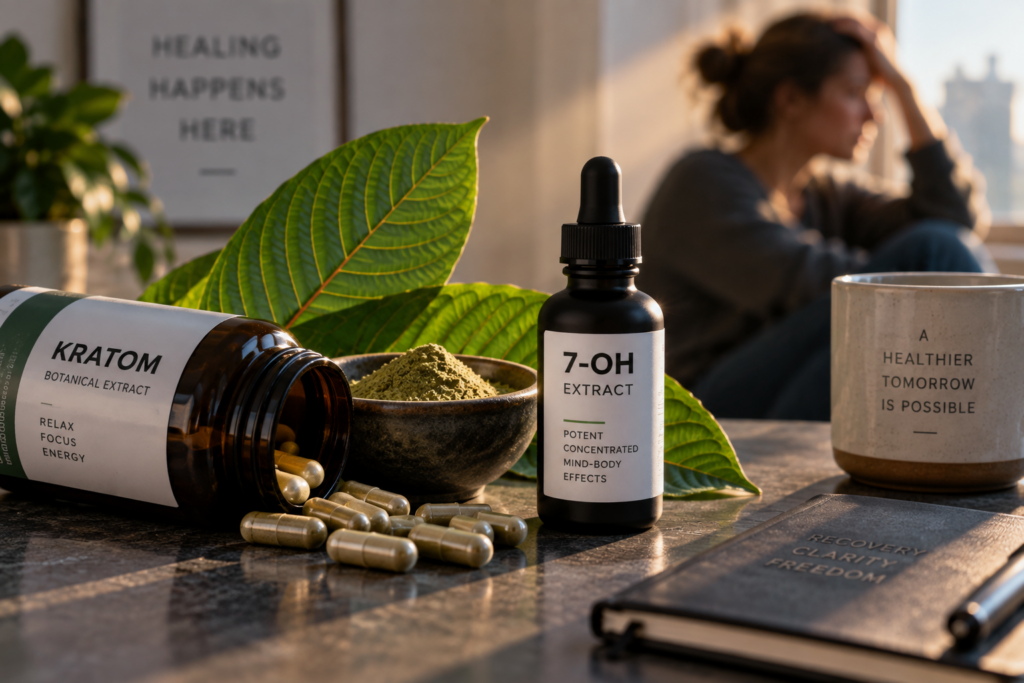
You may have seen kratom products sold online, in smoke shops, convenience stores or even gas stations. They can look more like supplements than drugs, which can make them seem relatively harmless.
But a newer product is raising serious concerns among addiction specialists and health officials: 7-OH, short for 7-hydroxymitragynine.
Kratom comes from the leaves of the Mitragyna speciosa tree, which is native to Southeast Asia. The plant naturally contains compounds that interact with opioid receptors in the brain. One of those compounds is 7-OH, but it occurs naturally in kratom leaves in very small amounts.
The concern today is concentrated 7-OH. Some products sold as tablets, gummies, shots or extracts contain much higher concentrations than what occurs naturally in the kratom plant. The FDA has warned that these concentrated products can have potent opioid-like effects and may lead to dependence and withdrawal.
That distinction matters. Someone purchasing a 7-OH tablet or extract may believe they are simply trying another kratom or herbal product when what they are taking can affect the body much differently.
And people are increasingly running into problems. Reports involving 7-OH have risen rapidly, while federal health and drug enforcement agencies have increased their scrutiny of concentrated products. For families in Boise, Meridian and throughout the Treasure Valley, understanding 7-OH addiction and kratom dependence starts with understanding what these substances actually are.
WHAT IS KRATOM AND WHAT IS 7-OH?
Kratom is a plant derived from the leaves of Mitragyna speciosa, a tree native to Southeast Asia. Traditionally, kratom leaves have been chewed or brewed into tea. Today, kratom is also sold in the United States as powders, capsules, extracts and other products.
Kratom contains several naturally occurring compounds. The most abundant is mitragynine. Another is 7-hydroxymitragynine, commonly called 7-OH.
Both can interact with opioid receptors in the brain, but 7-OH is especially important because of its potent opioid-like activity. Here is where things get confusing.
7-OH occurs naturally in kratom, but only in very small amounts. The concentrated 7-OH products being sold today can be very different from traditional kratom leaf.
Some manufacturers process or formulate products to contain much higher concentrations of 7-OH. These products may be sold as tablets, gummies, shots, extracts or other easy-to-use forms.
The U.S. Food and Drug Administration has specifically warned consumers about concentrated 7-OH products, describing 7-OH as a potent opioid and warning that these products may cause addiction and withdrawal.
That means seeing the word “kratom” on a package doesn’t necessarily tell you how potent the product is or how much 7-OH it contains.
KRATOM VS. CONCENTRATED 7-OH
Think of the distinction this way:
Traditional kratom: A botanical product containing many naturally occurring compounds, including small amounts of 7-OH.
Concentrated 7-OH: A product formulated to deliver substantially more 7-OH and potentially much stronger opioid-like effects.
That difference is one reason concentrated 7-OH has attracted so much attention from health officials. And because these products may be sold in places where consumers normally encounter supplements, energy products or tobacco alternatives, someone may begin using them without realizing physical dependence and 7-OH withdrawal can develop.
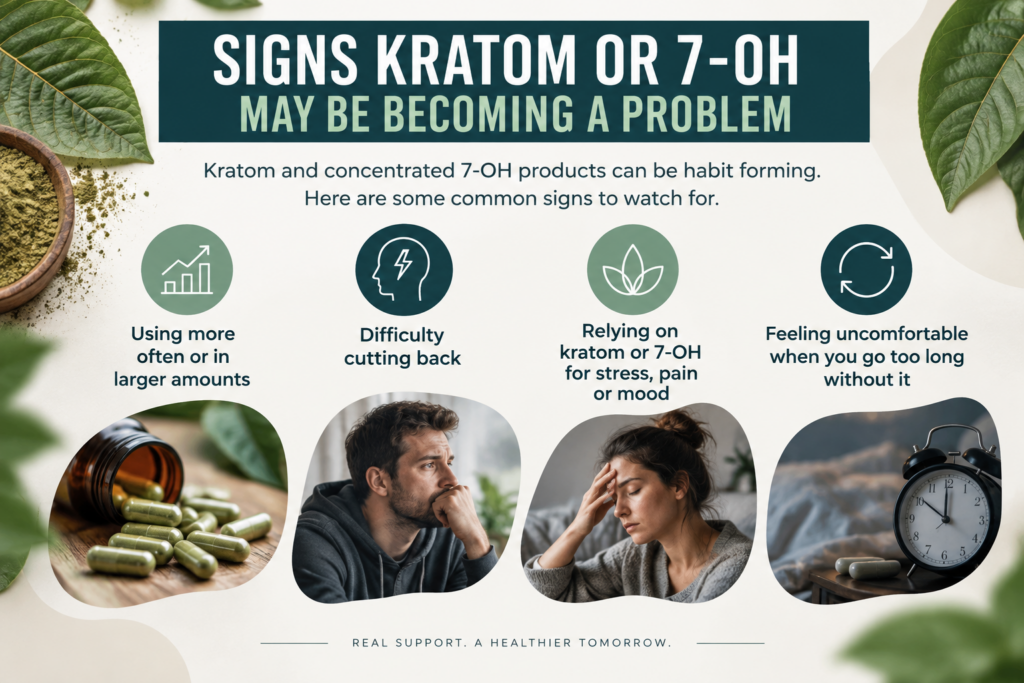
SIGNS KRATOM OR 7-OH USE MAY BE BECOMING A PROBLEM
Kratom or 7-OH use does not always begin with someone trying to get high.
A person may start using kratom for energy, pain, stress or to manage symptoms after stopping another substance. Someone may try a concentrated 7-OH product without fully understanding how different it can be from traditional kratom.
The pattern can change gradually. What started as occasional use can become daily use. A person may begin taking larger amounts, using more frequently or feeling uncomfortable when they go too long without it.
YOUR USE HAS GRADUALLY CHANGED
You might notice:
- You’re taking kratom or 7-OH more frequently than you used to.
- You need more of the product to get the effect you once felt with less.
- You think about when you’ll be able to take your next dose.
- You use it to get through work, sleep, stress or everyday responsibilities.
- You’ve tried to cut back but keep returning to the same pattern.
- You become anxious about running out.
- You’re spending more money on kratom or 7-OH than you intended.
- You hide or minimize how much you’re using.
- Friends or family have expressed concern.
- You feel physically or emotionally worse when you don’t take it.
Not every one of these signs means someone has an addiction. But patterns matter. If you’re repeatedly trying to reduce your use and finding that you can’t, or you’re continuing primarily because stopping makes you feel sick, it may be time to take a closer look.
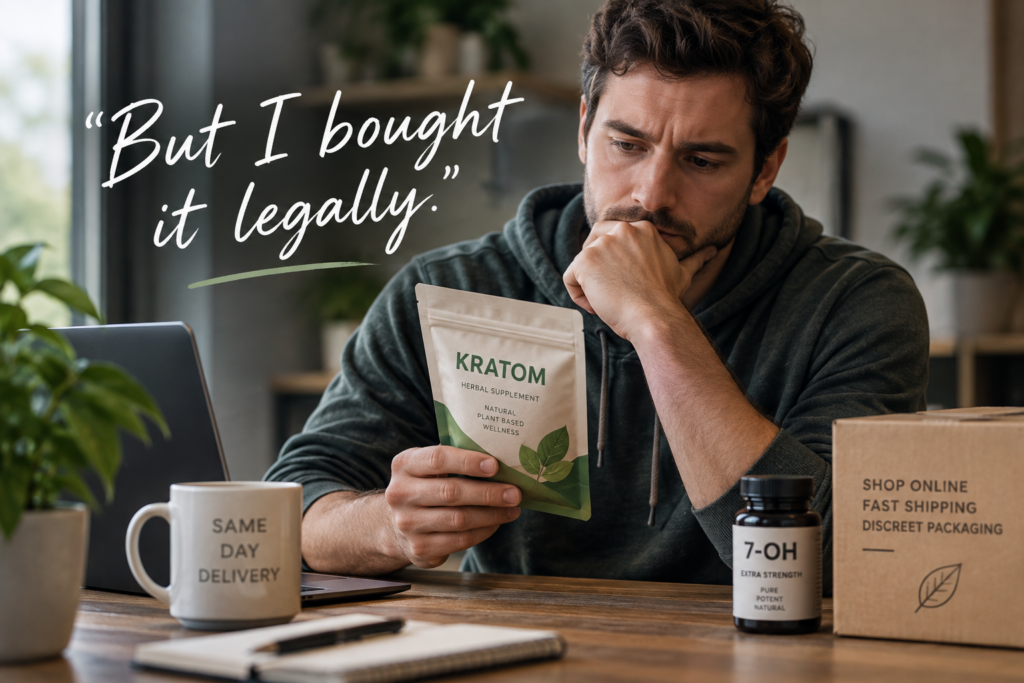
“BUT I BOUGHT IT LEGALLY.”
This is one reason kratom addiction and 7-OH dependence can be difficult to recognize.
Someone may think:
- “I bought it at a store.”
- “It comes from a plant.”
- “It isn’t heroin or fentanyl.”
- “I can still go to work.”
- “I only take it because it helps me feel normal.”
- “I can stop whenever I want.”
Those things can make it easy to dismiss changes in your use. But whether a product is sold legally or comes from a plant does not determine whether physical dependence can develop.
The more useful question is: What happens when you try to stop?
If skipping a dose leaves you feeling sick, restless, anxious or intensely focused on taking more, your body may have adapted to the substance.
DEPENDENCE CAN HAPPEN BEFORE LIFE FALLS APART
A person can have a job, maintain relationships, take care of their family and still be struggling with a substance.
You don’t have to lose everything before asking whether your use has become difficult to control. In fact, recognizing a problem earlier may give you more options for addressing it before the consequences become more severe. For people using concentrated 7-OH, one of the clearest warning signs may be the emergence of 7-OH withdrawal symptoms when they try to cut back or stop.
WHAT HAPPENS WHEN YOU STOP USING 7-OH OR KRATOM?
One of the clearest signs that occasional use has turned into physical dependence is what happens when you try to stop. People who regularly use kratom or concentrated 7-OH may experience withdrawal when they suddenly reduce or discontinue use.
WHAT DOES 7-OH WITHDRAWAL FEEL LIKE?
Withdrawal can vary depending on the product, how concentrated it is, how much you’re taking, how frequently you use it and how long you’ve been using it.
Reported symptoms can include:
- Restlessness
- Anxiety or irritability
- Body aches
- Sweating or chills
- Fatigue
- Difficulty sleeping
- Nausea or other gastrointestinal symptoms
- Strong cravings or urges to take another dose
The FDA has specifically warned that concentrated 7-OH products can lead to addiction and withdrawal and has received reports of people experiencing significant adverse effects associated with these products.
This is also why someone who began taking 7-OH because it made them feel better may eventually find themselves taking it for a very different reason:
Not to feel good, but to avoid feeling bad.
WHY 7-OH IS GETTING SO MUCH ATTENTION NOW
Health officials are increasingly concerned because concentrated 7-OH products can contain levels far beyond the small amounts naturally found in kratom leaves.
And reports involving these products are increasing.
America’s Poison Centers reported 593 exposures involving 7-OH during all of 2025. In just the first six months of 2026, that number had already reached 901. Among exposures involving 7-OH alone, serious health effects and hospitalizations were reported.
In July 2026, the DEA also announced action aimed specifically at concentrated 7-OH and related substances. Importantly, the federal action distinguishes these concentrated products from ordinary botanical kratom containing naturally occurring trace amounts of 7-OH.
That distinction matters because the bottle, gummy, tablet or shot someone buys today may be very different from the traditional kratom product they think they’re using.
WHEN IT MAY BE TIME TO ASK FOR HELP
You don’t have to wait for kratom or 7-OH use to become a crisis.
If you’ve tried to stop and can’t, experience withdrawal between doses, need increasing amounts to feel the same effect or find yourself using primarily to avoid feeling sick, those are reasons to talk with an addiction professional.
The goal isn’t to label you. It’s to understand what’s happening and determine what kind of support may help.
WHAT IF YOU REALIZE YOU CAN’T STOP KRATOM OR 7-OH ON YOUR OWN?
Realizing that kratom or 7-OH has become difficult to stop does not automatically mean you need to leave your job, family and home to enter residential treatment.
Addiction treatment comes in different levels of care, and the right approach depends on your pattern of use, withdrawal symptoms, physical health, mental health and whether other substances are involved.
For someone experiencing 7-OH withdrawal, the first step may be determining whether withdrawal can be managed safely and what level of support is appropriate. Because concentrated 7-OH can produce opioid-like effects, it is important to be honest about exactly what products you are taking, how often you use them and whether you are also using alcohol, opioids or other substances.
At Zelus Recovery in Meridian, treatment is individualized rather than based on a one-size-fits-all approach.
Zelus provides kratom addiction treatment in Boise and the Treasure Valley through multiple levels of outpatient care, allowing many people to receive structured support while continuing to live at home.
INTENSIVE OUTPATIENT PROGRAM (IOP)
An Intensive Outpatient Program in Boise provides structured addiction treatment without requiring someone to live at a treatment facility.
For someone struggling with kratom addiction or 7-OH dependence, treatment may focus not only on stopping substance use but also on understanding what led to it.
Was kratom originally being used for pain?
- Stress or anxiety?
- Energy?
- Sleep?
- Or as an attempt to stop using another substance?
Understanding those underlying reasons can be an important part of building a recovery plan that lasts.
IOP can be especially helpful for people who need more support and accountability while continuing to manage work, school or family responsibilities.
PARTIAL HOSPITALIZATION PROGRAM (PHP)
Some people need a higher level of structure and support.
Zelus Recovery’s Partial Hospitalization Program provides more intensive daytime treatment while allowing participants to return home outside treatment hours.
PHP may be appropriate when substance use has become more difficult to control, withdrawal and cravings are interfering with daily life, mental health concerns are also present or a person needs more support than traditional outpatient treatment can provide.
The appropriate level of care depends on the individual.
You don’t have to know which program you need before reaching out. An assessment can help determine what is happening, whether additional medical support is needed and which level of treatment is most appropriate.
WHAT ABOUT WITHDRAWAL FROM KRATOM OR 7-OH?
If you’ve been using kratom or concentrated 7-OH regularly, stopping can cause withdrawal symptoms.
WITHDRAWAL AND ADDICTION TREATMENT AREN’T THE SAME THING
Getting through 7-OH or kratom withdrawal is only one part of recovery.
Addiction treatment also addresses cravings, triggers and the reasons someone began relying on the substance in the first place. If you’re experiencing withdrawal or aren’t sure whether you can safely stop on your own, talk with a healthcare or addiction professional about your individual situation.

You Don’t Have to Decide Whether You’re “Bad Enough” for Help
This may be the most important part of the conversation.
- You don’t need to prove that your drinking is severe enough.
- You don’t have to call yourself an alcoholic.
- You don’t have to hit rock bottom.
- And you don’t have to wait until alcohol causes a crisis.
Sometimes Recovery Starts With a Question
- Maybe you’re simply curious about what life would feel like without drinking.
- Maybe you’ve tried cutting back and can’t understand why it’s so difficult.
- Maybe someone you love has expressed concern.
- Or maybe you already know something needs to change.
All of those are valid reasons to have a conversation.
KRATOM AND 7-OH ADDICTION TREATMENT IN BOISE AND MERIDIAN
Zelus Recovery provides individualized addiction treatment for adults, adolescents and families in Boise, Meridian and throughout the Treasure Valley.
If kratom or 7-OH use has become difficult to control, treatment can help you understand what is happening, address the reasons behind your substance use and build a plan for recovery.
Learn more about drug addiction treatment at Zelus Recovery.
You don’t have to wait until substance use has taken over your life to ask for help. Call Zelus Recovery at 208.518.0797 for a confidential consultation.
Frequently Asked Questions About Kratom, 7-OH
What is 7-OH?
7-OH is short for 7-hydroxymitragynine, a compound that occurs naturally in the kratom plant in small amounts. Concentrated 7-OH products can contain much higher levels and produce potent opioid-like effects.
Is 7-OH the same thing as kratom?
Not exactly. Traditional kratom contains several naturally occurring compounds, including small amounts of 7-OH. Concentrated 7-OH products are formulated to contain much higher levels and may have stronger effects than traditional kratom leaf.
Can you become addicted to kratom or 7-OH?
Yes. Regular use can lead to physical dependence, and concentrated 7-OH products have raised particular concerns because of their opioid-like effects. Warning signs can include increasing tolerance, cravings, difficulty cutting back and continuing to use despite negative consequences.
What are the symptoms of 7-OH or kratom withdrawal?
Withdrawal symptoms may include restlessness, anxiety, irritability, body aches, sweating, fatigue, difficulty sleeping, gastrointestinal symptoms and cravings. Symptoms can vary depending on the product, amount used and frequency of use.
Is 7-OH legal?
The legal and regulatory status of concentrated 7-OH products is changing. In 2026, federal authorities increased scrutiny of concentrated 7-OH and related substances. This is different from ordinary botanical kratom containing naturally occurring trace amounts of 7-OH.
Where can I get help for kratom or 7-OH addiction in Boise?
Zelus Recovery in Meridian provides addiction treatment for people throughout Boise, Meridian and the Treasure Valley. Treatment options include outpatient care, Intensive Outpatient Programs (IOP) and Partial Hospitalization Programs (PHP), depending on an individual’s needs.