
Addiction Isn’t a Choice. It’s a Brain Disease.
For generations, addiction was viewed as a personal failure. People struggling with drugs or alcohol were often told they simply needed more self-control, stronger morals, or greater willpower.
Today, science tells us something very different.
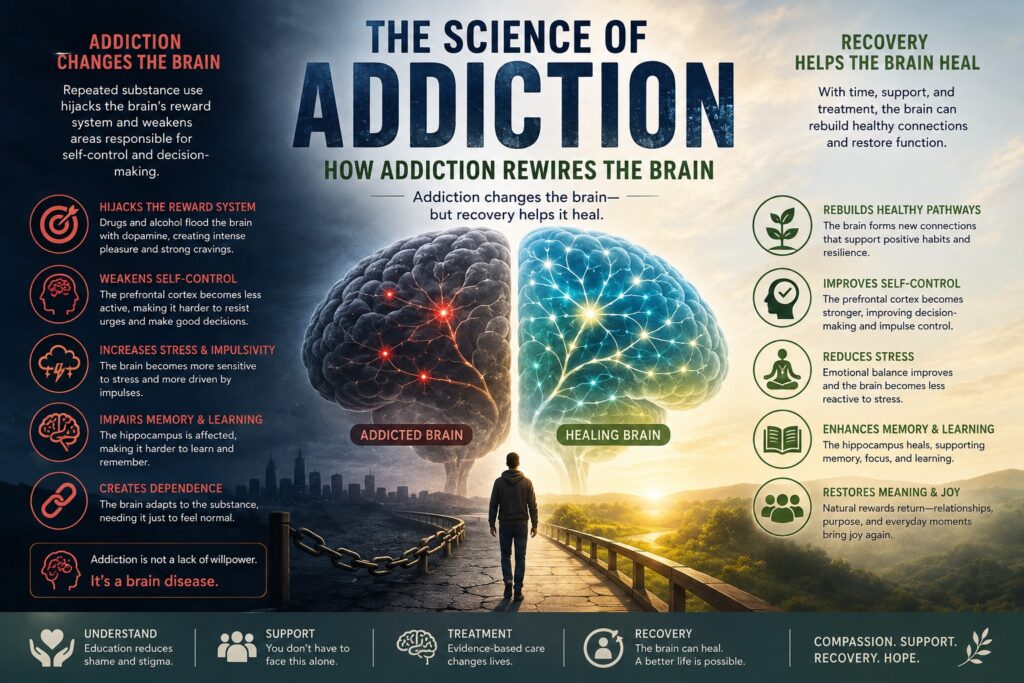
The science of addiction has shown that repeated substance use physically changes the brain. Addiction is now recognized as a chronic brain disease because it affects the areas responsible for judgment, impulse control, motivation, decision-making, memory, and reward.
Understanding how addiction rewires the brain doesn’t remove personal responsibility, but it does explain why quitting is often far more difficult than simply making the decision to stop.
For many families, this knowledge becomes a turning point. Instead of asking, “Why won’t they quit?” they begin asking, “What has happened to their brain, and how can they heal?”
That shift in perspective often opens the door to compassion, healthier boundaries, and the willingness to seek professional help.
At Zelus Recovery, we help individuals and families throughout Boise, Meridian, Nampa, Caldwell, Eagle, Kuna, Star, Middleton, and the Treasure Valley understand both the emotional and neurological sides of addiction. Whether someone needs our Detox at Home program, Intensive Outpatient Program (IOP), or another level of care, education is one of the first steps toward lasting recovery.
Learn more about our Detox at Home program:
https://www.zelusrecovery.com/detox-at-home/
Explore our Intensive Outpatient Program:
https://www.zelusrecovery.com/intensive-outpatient-program/
How Addiction Affects the Brain
Your brain is designed to keep you alive.
Every time you eat a meal, spend time with people you love, accomplish a goal, or experience something enjoyable, your brain releases dopamine. Dopamine is one of the chemicals responsible for creating feelings of pleasure, motivation, and reward.
Drugs and alcohol hijack this natural reward system.
Instead of releasing healthy amounts of dopamine, many substances flood the brain with levels far beyond what the body naturally produces. The brain quickly learns to associate those substances with relief, pleasure, confidence, or escape.
Over time, the brain begins prioritizing drugs or alcohol over everyday experiences.
Activities that once brought happiness—family dinners, vacations, hobbies, sports, work achievements, or simply spending time with loved ones—may no longer create the same feeling of reward.
This is one of the biggest brain changes caused by addiction.
As addiction progresses, many people don’t continue using because they’re trying to get high. They continue using because their brain has adapted to needing the substance just to feel normal.
According to the National Institute on Drug Abuse (NIDA), repeated substance use changes brain circuits involved in reward, stress, learning, and self-control, making recovery much more challenging without treatment and support.
The National Institute on Alcohol Abuse and Alcoholism (NIAAA) also explains that alcohol changes communication pathways in the brain, affecting mood, behavior, learning, and decision-making over time.
Why Understanding the Science of Addiction Matters
When families understand how addiction affects the brain, many begin seeing their loved one differently.
Instead of believing someone simply doesn’t care, they begin recognizing that addiction has changed the way the brain processes motivation, consequences, and decision-making.
That understanding doesn’t excuse harmful behavior.
Healthy boundaries are still important.
Accountability still matters.
But shame alone rarely helps someone recover.
Compassion combined with evidence based treatment creates a stronger foundation for healing.
Recovery isn’t about fixing a broken person.
It’s about helping the brain develop healthier pathways while addressing the emotional, physical, and psychological challenges that often accompany substance use disorder.
That’s why comprehensive treatment includes much more than stopping drug or alcohol use. It may also involve therapy, family support, relapse prevention, trauma treatment, coping skills, mental health care, and long-term recovery planning.
If you’re wondering whether it’s time to seek help for yourself or someone you love, our Admissions team is here to answer your questions without pressure or judgment.
You can also contact our team directly to learn more about treatment options available in Boise and throughout the Treasure Valley.