


Menu Close
Zelus Recovery logo

Recovery is a team effort

Sober Curious? What Gray-Area Drinking Can Tell You About Your Relationship With Alcohol

Sober curious adult considering their relationship with alcohol in Boise Idaho

You don’t have to consider yourself an alcoholic to start questioning your relationship with alcohol.

Maybe you’ve noticed you don’t sleep as well after drinking.

Maybe one glass of wine has slowly become two or three.

Maybe drinking has become your automatic way to relax after a stressful day.

Or maybe nothing dramatic has happened at all. You simply don’t like the role alcohol is beginning to play in your life.

That’s where the growing conversation around being “sober curious” comes in.

For people throughout Boise, Meridian and the Treasure Valley, questioning your relationship with alcohol doesn’t necessarily mean you have an addiction. Sometimes it simply means you’re paying attention.

And that can be a very healthy place to start.

What Does Sober Curious Mean?

Being sober curious means becoming more intentional about when, why and how much you drink rather than automatically drinking because it’s part of your routine or social life.

The National Institute on Alcohol Abuse and Alcoholism has highlighted the sober-curious movement and the changing conversation around alcohol, particularly among younger adults.

You don’t necessarily have to commit to never drinking again.

Instead, you might begin asking questions like:

Why am I drinking tonight?

Am I drinking because I want to or because it’s what I always do?

Could I comfortably go several weeks without alcohol?

Does drinking make my life better?

How do I physically and emotionally feel the day after drinking?

Those questions can reveal much more about your relationship with alcohol than simply counting drinks.

What Is Gray-Area Drinking?

You may have also heard the term gray-area drinking.

It’s commonly used to describe drinking that doesn’t necessarily fit someone’s idea of severe alcohol addiction but still feels unhealthy, uncomfortable or increasingly difficult to control.

Gray-Area Drinking Is Not a Medical Diagnosis

There isn’t a medical diagnosis called “gray-area drinking.”

Alcohol Use Disorder, or AUD, is diagnosed using specific clinical criteria and can range from mild to severe.

But there’s an important point people often miss:

Alcohol problems don’t have to become severe before they’re worth addressing.

Someone can have a career, raise children, pay the mortgage, attend social events and appear completely successful while privately wondering whether they’re drinking too much.

If you’ve been asking yourself that question, read our related article, Do I Have a Drinking Problem? Honest Questions to Ask Yourself.

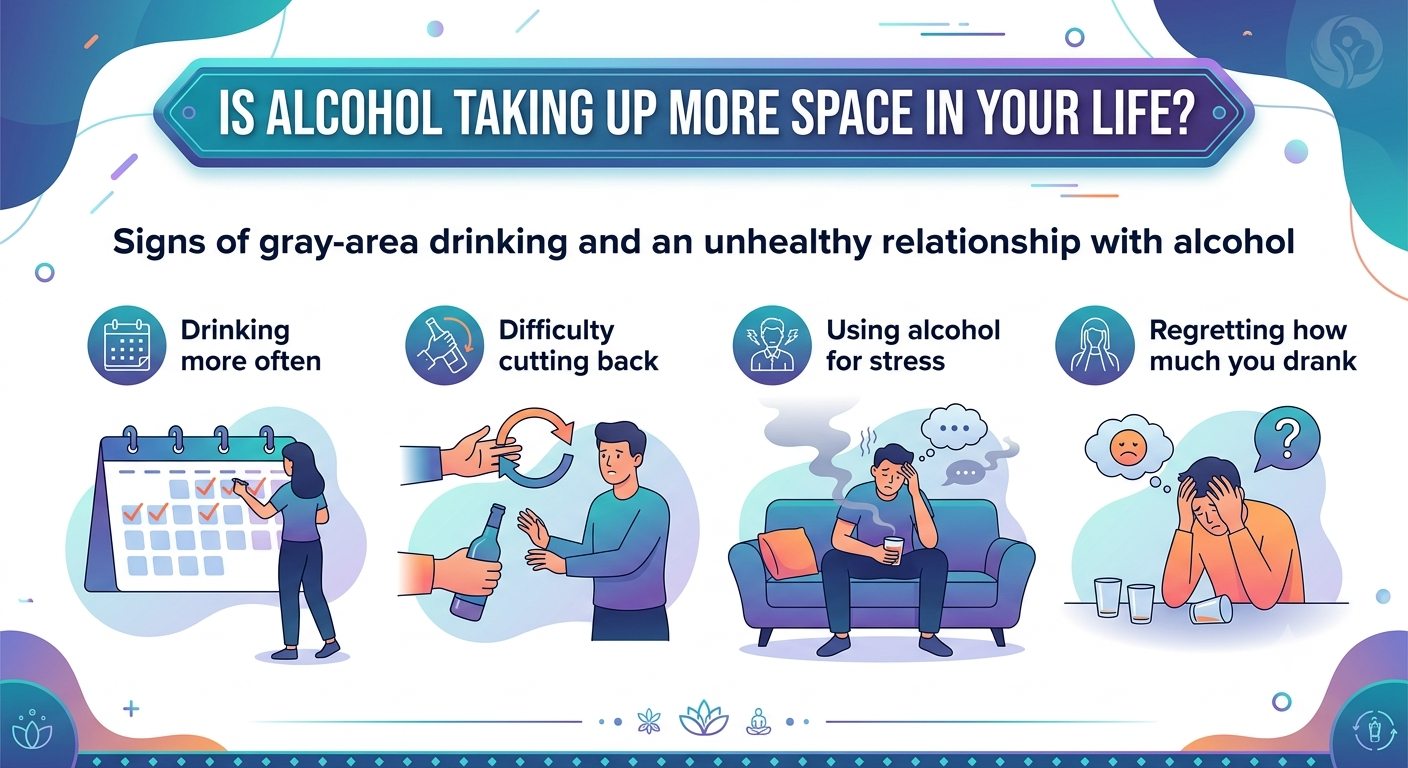
Signs of gray-area drinking and an unhealthy relationship with alcohol

Signs It May Be Worth Taking a Closer Look at Your Drinking

You don’t have to wait for a dramatic event to reconsider alcohol.

Sometimes the earliest warning signs are much quieter.

Your Drinking Habits Have Gradually Changed

You might notice:

  • You’re drinking more frequently than you used to.
  • One or two drinks regularly turns into more.
  • You use alcohol to cope with stress, anxiety or loneliness.
  • You look forward to drinking throughout the day.
  • You regularly wake up regretting how much you drank.
  • You’ve tried to cut back but keep returning to the same pattern.
  • Your sleep or mood seems worse after drinking.
  • Someone close to you has commented on your drinking.
  • You find yourself hiding or minimizing how much you consume.
  • Social activities increasingly revolve around alcohol.

None of these signs alone diagnose Alcohol Use Disorder.

But patterns matter.

If you’re repeatedly wondering whether alcohol has become a problem, that question itself deserves attention.

“But I’m Not an Alcoholic.”

This is one of the biggest reasons people wait to ask for help.

They compare themselves to the most severe image of addiction and think:

“I still go to work.”

“My family is still together.”

“I don’t drink every day.”

“I’ve never gotten a DUI.”

“I can stop when I really want to.”

Therefore, alcohol must not be a problem.

You Don’t Have to Hit Rock Bottom

Addiction treatment isn’t reserved for people who have lost everything.

In fact, recognizing an unhealthy relationship with alcohol earlier gives you an opportunity to address what’s happening before the consequences become more severe.

Rather than asking:

“Am I an alcoholic?”

Consider asking:

“Is alcohol making my life better or harder?”

That question leaves much more room for an honest answer.

Taking a break from alcohol as part of the sober curious movement

Why Taking a Break From Alcohol Can Be Revealing

Some people explore sober curiosity by taking a temporary break from alcohol.

Pay Attention to What Happens When You Don’t Drink

Ask yourself:

Is taking a break relatively easy?

Do I think about drinking frequently?

Do social situations suddenly feel uncomfortable?

Do I find myself making exceptions?

Am I counting the days until I can drink again?

Do I notice changes in my sleep, energy or mood?

Research discussed by the National Institute on Alcohol Abuse and Alcoholism has found that participating in temporary alcohol-abstinence challenges may influence drinking habits even after the challenge ends.

A break isn’t a diagnostic test.

But it can give you valuable information about your relationship with alcohol.

When Cutting Back Feels Harder Than Expected

This is where sober curiosity can sometimes uncover something deeper.

You may begin with:

“I’m just going to drink less.”

Then discover that drinking less is surprisingly difficult.

Begin Recovery in a Familiar Environment

Being surrounded by familiar people and surroundings can reduce stress during an already difficult time.

Many people find greater comfort beginning recovery in their own home rather than an unfamiliar facility.

The Rules Keep Changing

Maybe you’ve told yourself:

Only weekends.

Only socially.

No drinking during the week.

Only two drinks.

No alcohol for 30 days.

But eventually those rules begin slipping.

If you’ve repeatedly tried to reduce your alcohol use and haven’t been able to maintain the change you wanted, it may be time to have a conversation with a professional.

That doesn’t automatically mean you need inpatient rehab.

It means it’s worth understanding what’s happening.

Why Alcohol Can Become Harder to Control

Repeated alcohol and drug use can affect brain systems involved in reward, motivation, stress, decision-making and behavioral control.

The National Institute on Drug Abuse explains how continued substance use can affect brain circuits involved in reward, stress and self-control.

Addiction Isn’t Simply About Willpower

Understanding what’s happening in the brain helps explain why someone can genuinely want to stop drinking while continuing to struggle.

It can also change the way families look at addiction.

Someone can genuinely love their spouse, children and career while simultaneously struggling to control substance use.

Understanding Creates Room for Compassion

Compassion doesn’t mean ignoring harmful behavior.

It doesn’t mean eliminating boundaries or accountability.

It means recognizing that shame alone doesn’t treat addiction.

Understanding what’s happening can help shift the conversation from:

“Why won’t you just stop?”

to:

“What’s happening, and what kind of help do you need?”

What If You Realize You Need More Than a Break?

Recognizing that alcohol has become a problem doesn’t automatically mean leaving your job, family and home to enter residential treatment.

There are different levels of addiction treatment.

The Substance Abuse and Mental Health Services Administration provides information about different types of behavioral health and substance use treatment.

At Zelus Recovery in Meridian, treatment is individualized based on each person’s needs.

Zelus offers multiple levels of addiction treatment in Boise and the Treasure Valley, including outpatient care, intensive outpatient treatment and partial hospitalization.

Intensive Outpatient Program (IOP)

An Intensive Outpatient Program in Boise provides structured addiction treatment without requiring someone to live at a treatment facility.

This can be particularly helpful for people who need more support while continuing to manage work, school or family responsibilities.

Partial Hospitalization Program (PHP)

Some people need a higher level of structure and support.

Zelus Recovery’s Partial Hospitalization Program provides structured daytime treatment while allowing participants to return home outside treatment hours.

The appropriate level of care depends on the individual, which is why an assessment is important.

What About Detoxing From Alcohol?

This is an important distinction.

If you drink heavily or regularly, don’t assume suddenly stopping alcohol on your own is safe.

Alcohol withdrawal can become medically serious for some people.

Detox and Addiction Treatment Aren’t the Same Thing

Detox addresses the body’s immediate response to stopping alcohol.

Treatment goes further by addressing behaviors, emotions, relationships, triggers and other factors that may contribute to continued alcohol use.

If you’re worried about withdrawal, learn more about alcohol detox at home in Boise and speak with an appropriate healthcare professional about your individual situation before attempting to detox.

Alcohol addiction treatment and recovery support in Boise Idaho

You Don’t Have to Decide Whether You’re “Bad Enough” for Help

This may be the most important part of the conversation.

You don’t need to prove that your drinking is severe enough.

You don’t have to call yourself an alcoholic.

You don’t have to hit rock bottom.

And you don’t have to wait until alcohol causes a crisis.

Sometimes Recovery Starts With a Question

Maybe you’re simply curious about what life would feel like without drinking.

Maybe you’ve tried cutting back and can’t understand why it’s so difficult.

Maybe someone you love has expressed concern.

Or maybe you already know something needs to change.

All of those are valid reasons to have a conversation.
Alcohol Treatment in Boise, Meridian and the Treasure Valley

Zelus Recovery provides individualized addiction treatment for adults, adolescents and families from Boise, Meridian and communities throughout the Treasure Valley.

Treatment isn’t about putting a label on someone.

It’s about understanding what’s happening, determining what level of support may be appropriate and helping people move toward a healthier life.

Learn more about alcohol addiction treatment at Zelus Recovery.

If you’ve been wondering about your relationship with alcohol, you don’t have to figure it out alone.

Call Zelus Recovery at 208.518.0797 for a confidential consultation.

Sometimes recovery doesn’t begin with hitting rock bottom.

Sometimes it begins with simply becoming curious about whether life could feel better.

Frequently Asked Questions About Sober Curiosity and Gray-Area Drinking

Sober curious generally describes intentionally questioning your relationship with alcohol. Someone may reduce their drinking, take temporary breaks from alcohol or choose sobriety without necessarily identifying as having an alcohol addiction.

No. Gray-area drinking is not a clinical diagnosis. Alcohol Use Disorder is a diagnosable condition that ranges from mild to severe. However, someone doesn’t need to meet criteria for severe AUD before reconsidering their drinking or seeking professional guidance.

Yes. Drinking every day isn’t required for alcohol to negatively affect someone’s life. Patterns such as repeatedly drinking more than intended, difficulty cutting back, cravings or continued drinking despite negative consequences may warrant a closer look.

No. Sober curiosity is about examining your relationship with alcohol. Some people ultimately choose sobriety, while others use the experience to become more intentional about drinking.No. Sober curiosity is about examining your relationship with alcohol. Some people ultimately choose sobriety, while others use the experience to become more intentional about drinking.

Difficulty stopping or repeatedly returning to alcohol despite wanting to cut back can be a reason to talk with an addiction treatment professional. Zelus Recovery offers individualized treatment options for adults and adolescents in Boise, Meridian and the Treasure Valley.

Not for everyone. Alcohol withdrawal can be dangerous for people who have developed physical dependence. Anyone concerned about withdrawal should seek appropriate medical guidance rather than assuming detoxing alone is safe.